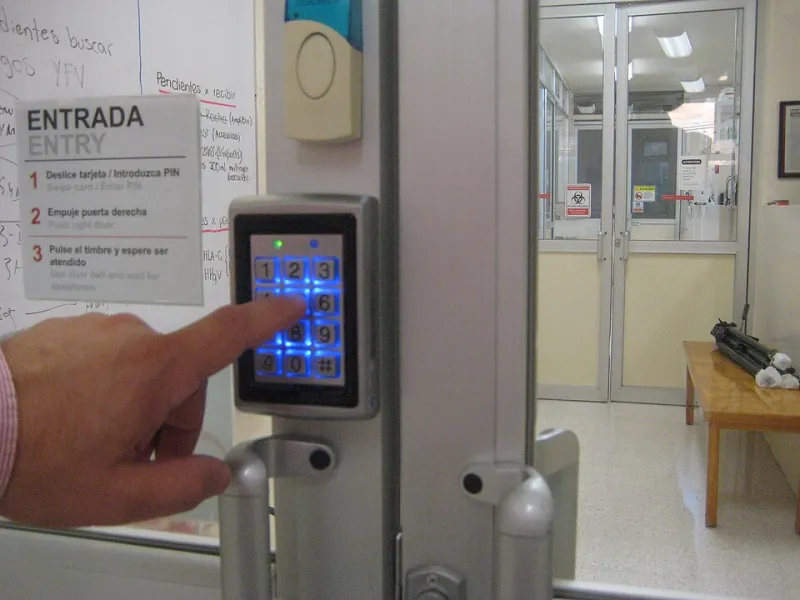
Rehearse the Lockout: Building a Staging Environment for Access Policies
Photo: Chris Reynolds, CC BY-SA 2.0, via Wikimedia Commons
Most engineering organizations in the United States would never push an untested database migration to production on a Friday afternoon. Yet the same teams routinely flip access-control rules — a geofence radius here, a key rotation there — with no rehearsal space at all. The change either works or it locks a delivery driver out of a distribution center in Ohio at 6 a.m.
The gap is cultural as much as technical. Staging environments are standard for application code; they barely exist for access policy. This article makes the case for what we'll call the staging building: a full simulation layer where geofences, permission changes, and credential lifecycles can fail safely before they touch a real door or a production API.
Why Access Policy Skipped the Staging Phase
Application deployments got staging because the failure mode was obvious and immediate: the site goes down, the on-call engineer gets paged, the postmortem gets written. Access-control failures are quieter and crueler. A malformed permission rule doesn't crash anything — it simply denies the right person or admits the wrong one, sometimes for days before anyone notices.
There's also a structural excuse. Physical access systems were historically managed by facilities teams through vendor consoles, not by engineers using version control. Digital access — API keys, OAuth scopes, service credentials — lived in config files and dashboards. Neither world inherited the CI/CD discipline the other took for granted. As these domains converge, with geofences acting as credentials and mobile devices acting as keys, the absence of a rehearsal environment becomes harder to defend.
Anatomy of a Staging Building
A credible simulation environment for access policy needs four components.
A synthetic geography. You need a mirror of your real-world footprint — building outlines, parking lots, dock doors — rendered as test geofences. Tools that support polygon imports (GeoJSON is the lingua franca) let you clone your actual sites into a sandbox coordinate space. A staging geofence in a simulated Denver warehouse behaves identically to its production twin, minus the consequences.
Synthetic actors. Virtual badges, test service accounts, and simulated device sessions let you walk a credential through its full lifecycle: issuance, use, rotation, revocation. A well-built staging environment can answer questions like "what happens to an active session when its underlying key rotates mid-shift?" without involving a single human being.
A policy diff engine. Before any change ships, the staging system should render the delta: who gains access, who loses it, which geofences shift. Think of it as terraform plan for doors. A rule change that silently widens a contractor's access from one loading bay to the entire campus should surface in a reviewable diff, not in a security incident.
Failure injection. This is the piece most teams skip. Deliberately degrade the environment — latency spikes, offline lock controllers, expired certificates — and watch how your access logic behaves. Offline-first designs in particular deserve hostile rehearsal; a lock that can't reach the policy server needs to make correct decisions on its own, and you want to learn that in staging.
What to Rehearse First
Not every policy change warrants a full dress rehearsal. Prioritize the three classes of change with the worst blast radius:
- Geofence edits. Shifting a boundary by fifty feet can strand a fleet or open a perimeter. Re-render the fence in staging, replay historical device traces against it, and confirm no vehicle or person gets reclassified unexpectedly.
- Bulk rotations. Rotating a thousand credentials at once is a migration, not a config change. Rehearse it against synthetic actors, measure the propagation window, and validate that old and new credentials behave correctly during the overlap.
- Deny-by-default rollouts. Tightening access is noble and frequently catastrophic. Stage the tightened policy, run your entire access history against it, and count the false denials before you count on it.
That last technique — replaying historical access logs against a proposed policy — deserves emphasis. It's the access-control equivalent of running your test suite: cheap, automated, and brutally revealing. Most teams that try it for the first time discover dozens of legitimate workflows their new policy would have broken.
Making It Stick
A staging building only matters if policy changes are required to pass through it. That means wiring the simulation layer into your existing pipeline: policy files in version control, automated checks on every pull request, a promotion path from staging to production that mirrors how your application code already ships.
It also means assigning ownership. Access policy tends to be orphaned between security, platform, and operations teams. The organizations that succeed here give one team explicit custody of the simulation environment and treat failed rehearsals the way they treat failed CI runs — as normal, unremarkable, and mandatory to resolve.
The Standard Is Coming Whether You Build It or Not
Audit frameworks and cyber-insurance questionnaires are already asking how access changes are tested. Answering "we don't" is getting more expensive every year, both in premiums and in incidents. Building a staging building now — a synthetic geography, synthetic actors, a diff engine, and failure injection — costs a fraction of one lockout event at a single distribution center.
Developers earned staging environments for code by treating every deploy as a question worth answering safely. Access policy deserves the same courtesy. Map the sandbox first; then open the real doors.